Why Repeated Shapes Give a Border Its Rhythm
Repeated plant shapes give a border visual continuity. Learn how to sketch their pattern on paper and adjust spacing before moving plants.
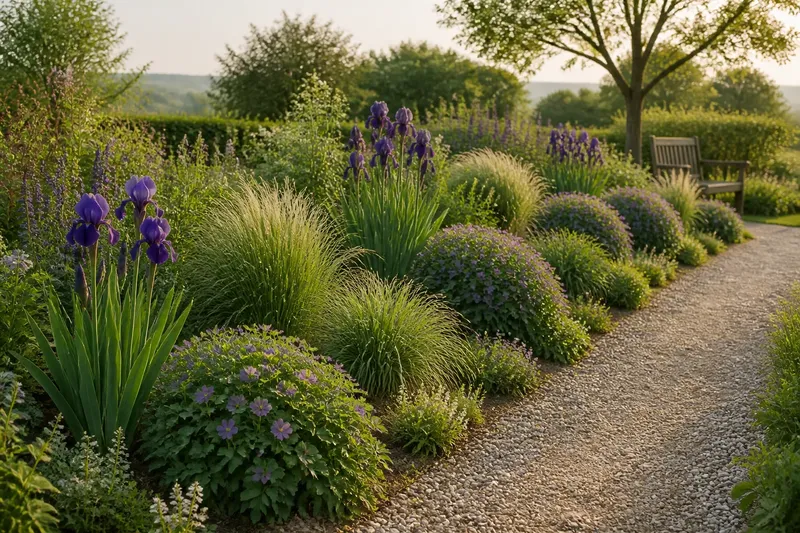
A border beside a gravel path can feel unsettled even when every plant is thriving. One clump rises like a fountain, the next spreads low, and a round mound appears only once. Repeated plant shapes give a border rhythm: the eye recognises a form, meets it again, and reads the planting as a connected whole.
Forms the eye can follow
Shape is the broad outline a plant makes from a usual viewing distance. It might be a narrow spire, a soft mound, an arching fountain or a low mat. It is not the same as flower colour, leaf texture or botanical family, though those qualities may reinforce the impression.
Choose a small vocabulary of forms rather than trying to repeat every plant. A border might use upright irises, rounded hardy geraniums and a few airy clumps of ornamental grass. The plants do not need to be identical. What matters is that their outlines read as related when viewed together.
Repetition works best when it gives the eye a return point. A rounded clump at one end can be echoed farther along, while an upright form marks a change in direction. If every plant has a different outline, the eye has little chance to recognise a pattern. If every outline is the same, the border can lose variation. A few recurring forms provide both continuity and contrast.
Rhythm along the bed
Think of a border as a line the eye travels, not a row of isolated specimens. Repeating a shape at intervals lets that visual line pause and continue. The spacing need not be exact. A tight group near a gate may make sense, while a more open stretch beside a bench leaves room for a focal plant.
Look at the border from the path, a window or another place where it is usually seen. A planting that seems evenly distributed from above may appear lopsided from the main viewpoint. Plants in the foreground can also hide those behind them, so a repeated form may need to shift slightly sideways to remain visible.
Let repetition cross small changes in planting. If a border turns a corner, carry one familiar shape around it, then adjust the next placement to suit the new view. This gives the eye a link without forcing the planting into a rigid pattern. Repeating a shape does not mean lining up plants like fence posts.
Sketch before moving plants
A paper plan is a cheap way to try arrangements before disturbing established roots. Draw the border as an outline, including its bends, narrow points, path and any fixed features such as a drain cover or established shrub. Mark the usual viewing position, since the plan should serve the view a person actually has.
Use simple symbols for broad forms: a narrow oval for an upright plant, a circle for a mound and a loose scalloped mark for an arching clump. Add the plant names beside the symbols, or use a small key. The drawing is not a planting instruction down to the last leaf. It is a way to see whether a shape recurs, whether the gaps feel deliberate and whether one area carries too much visual weight.
Say you have a curved border with three existing clumps of hardy geranium and one tall iris near the middle. On paper, mark the geraniums as rounded forms and try placing a fourth symbol near the far end, with another iris closer to the bend. From the path, the expected observable result is a clearer sequence of rounded masses interrupted by two upright accents. If the added symbols crowd the curve on the sketch, test a looser placement before moving anything.
To compare versions, trace the border outline onto separate sheets or use tracing paper. Keep the same fixed features in each drawing, then alter only the plant symbols. That makes it easier to tell whether a change in spacing has helped, rather than confusing it with a different plan for the whole bed.
Reading a paper plan
Small marks can hide practical problems. A mature plant may spread beyond the symbol you drew, while a seasonal plant can leave a gap when it dies back. Check plant labels and reliable nursery descriptions for mature form and siting needs; when a decision depends on a label, manufacturer instructions or local rules, follow those requirements.
Use the plan to ask specific questions before making changes:
- Can each repeated shape be seen? If one is hidden behind a taller neighbour, shift its symbol sideways or choose a more open position.
- Does the pattern survive the curve? If the intervals look forced, vary them while keeping the same forms recognisable.
- Is one shape doing all the work? If so, add a second recurring outline rather than more of the same plant by default.
- Will seasonal gaps break the sequence? If a plant disappears after flowering, pair its place with foliage that continues to mark the shape.
- Does the plan fit the space around it? Leave room for access, paths and existing plants instead of treating the border as a blank strip.
Once the sketch feels plausible, mark the proposed positions on the ground with plant pots, canes or temporary garden labels. Stand at the usual viewing point and look again. This simple pause can reveal that a theoretically tidy interval feels too regular, or that a repeated clump vanishes behind a shrub.
Questions about repetition?
How many plant shapes should a border repeat?
There is no fixed number. Begin with a few forms that already suit the border, then repeat the most useful ones where the view needs a link. A small bed often benefits from a simpler vocabulary than a deep, mixed border.
Do the plants need to be the same species?
No. Different plants can share a similar outline, such as several rounded perennials with distinct foliage. Check their growing needs separately; visual resemblance is not a reason to put unsuitable plants together.
Can colour create the same continuity?
Colour can connect separate areas, but it works differently from shape. A flower may be absent outside its flowering season, while the plant’s outline can remain visible for longer. Combining a repeated form with a restrained colour echo can make the link easier to notice.
Should repeated shapes be evenly spaced?
Not necessarily. Even spacing can make a border feel mechanical, especially around a bend or beside a feature that deserves attention. Use the sketch to test a rhythm that feels intentional without turning the plants into a row.
Keep the pattern adaptable
A border changes as plants mature, are divided or disappear. Treat the drawing as a working note, not a permanent design. When a plant is removed, ask whether its shape was carrying a useful link before replacing it with something entirely different.
Repeated plant shapes make a border easier to read, but the pattern should still respond to its setting. A sketch lets you compare that visual rhythm before disturbing the soil; a few temporary markers then let you check it from the path. Keep the forms that make the planting feel connected, and leave room for the garden to change around them.