The Garden-Care Calendar Trap
Garden-care calendars can mislead when dates ignore local conditions. Learn to read plant and soil cues, then keep flexible notes for timely, calmer upkeep.
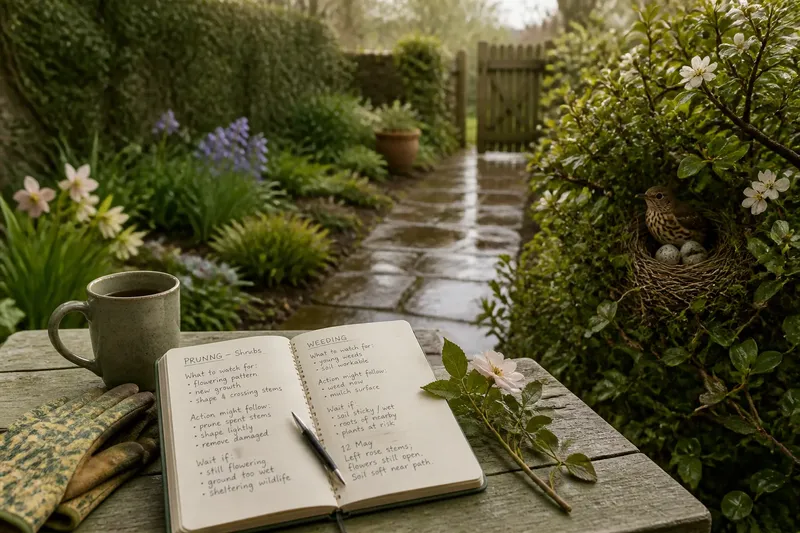
A printed garden calendar says to prune, but the hedge is still sheltering a clutch of birds and the ground is sodden underfoot. The date is clear; the garden is giving a different answer. A garden-care calendar can be useful as a reminder, but it becomes a trap when a month is treated as a universal signal to act.
The alternative is not to abandon planning. It is to build a flexible record around visible cues: what a plant is doing, what the soil feels like, and what the weather has allowed. The notes can still point you towards useful work, while leaving the final decision to the place in front of you.
Keep dates in their place
Month-by-month lists simplify gardening by attaching a task to a time. That can help you remember recurring work, especially if you are learning the names of plants or looking after a garden with several distinct areas. The problem is that a date travels more easily than the conditions that made the advice sensible.
A mild spell may bring growth forward in one garden, while a sheltered courtyard and an exposed plot nearby respond differently. Soil can remain wet after rain, or dry quickly beneath a roof overhang. A task that is suitable in one setting may be premature in another, even within the same neighbourhood.
Use dates as prompts to look, not commands to work. If a calendar says to check a shrub, let that reminder lead to an inspection. The inspection may confirm that pruning is timely, or it may tell you to leave the plant undisturbed and check again later.
Choose a cue for each task
Before changing your routine, list the jobs you usually do by month. For each, ask what condition would make the work useful. A useful cue is something you can observe without guessing at a date.
- Pruning: note the plant’s flowering pattern and the growth you can see. Different shrubs flower on different kinds of growth, so identify the plant before choosing a time.
- Weeding: look for young weeds that can be removed without disturbing the roots of nearby plants. The soil should be workable rather than sticky and easily compacted.
- Planting: check whether the soil is workable and whether the plant has a suitable period to establish, rather than relying on a named month alone.
- Watering: inspect the soil near the root zone and the plants’ condition. A dry-looking surface does not always tell you what is happening lower down.
- Cutting back: look for the plant’s growth stage, its condition and any shelter or seed heads that are still serving wildlife.
These are starting points, not substitute rules for every plant. Where the right timing depends on identification, a plant label or a particular method, check the label or the grower’s instructions once before acting.
Read the garden first
Make a slow circuit before taking out tools. Notice which plants are actively growing, which have finished flowering, where water is standing and where soil has begun to crumble rather than smear. Look at the whole bed, then examine the specific plant or patch connected to the task.
Keep the observation plain. “The soil is damp beneath the surface near the path” is more useful than “too wet”. “New shoots are appearing below the old flower stems” gives you something to compare next time. A pocket notebook works well; a notes app is handy if you prefer photographs alongside short observations.
Try to check from the same few vantage points when you can. A view from the kitchen window may show the border’s overall change, while a closer look by the gate reveals whether the soil is still holding water. Neither view replaces the other. The point is to gather cues that relate to the decision, rather than to collect observations for their own sake.
Turn observations into notes
For each recurring job, write down three things: what to watch for, what action might follow, and what would make you wait. This turns a vague reminder into a small decision aid. Keep it brief enough to use in the garden.
Say you have a rose whose flowering stems you usually shorten because a calendar suggests a seasonal pruning window. You write: “Check for spent flowers; identify which stems need shaping; wait if the plant is still flowering or the ground is too wet to work around it.” On the next visit, you see that the flowers remain and the soil is soft. The expected result is a clear reason to postpone, rather than a job done simply because the page says so.
After a task, add a short note about what you did and what you saw. Avoid broad conclusions from a single visit. “Left the stems; flowers still open” is a record, not a verdict on what will suit the plant every year. Over time, notes can help you recognise how your own garden responds, while leaving room for seasons to differ.
Use a flexible task queue
Instead of assigning every task to a week, sort work by readiness. One page can hold three groups:
- Ready: the cue is present and the task is suitable to do now.
- Watch: a relevant change has started, but the cue is incomplete.
- Wait: conditions make the task unhelpful for now, or the plant still needs to finish its current stage.
Move a task between groups when you next inspect the garden. A waterproof tag on a shed hook, a notebook by the back door or a simple phone note can all serve; choose the one you will actually revisit. If a task depends on a particular plant, include its name and location, so “check the clematis by the trellis” does not become a puzzle later.
This queue also helps keep urgent work distinct from optional tidying. A fallen branch that blocks a path calls for attention sooner than removing healthy stems for appearance alone. If a job raises a safety concern, such as working at height or handling a powered tool, leave it to someone suitably qualified rather than letting a calendar create pressure to proceed.
What should replace a monthly list?
Should I stop using a garden calendar?
No. Keep it for reminders to inspect, and let the garden determine whether work is ready. A recurring note is useful when it sends you outside to check, rather than telling you to act without looking.
How often should I check the garden?
Choose a rhythm that fits your available time and the work under way. A brief circuit after a spell of unsettled weather may matter more than a fixed weekly visit, while a quiet period may need little attention beyond occasional observation.
What if I cannot identify a plant?
Do not make a timing-sensitive cut based on a guess. Photograph the leaves, flowers and overall form, then ask a local nursery or knowledgeable gardening group to help identify it before choosing the task.
How do I keep notes from becoming another chore?
Record only what changes a decision: the plant, the cue, and whether you acted or waited. A short phrase or one labelled photograph is enough to make the next inspection more useful.
Review without forcing a pattern
At the end of a season, look back through the notes and ask which reminders were useful. Did a particular corner stay wet longer than you expected? Did a plant finish flowering later than your old calendar suggested? Revise the cue or the reminder, rather than trying to make the garden fit a tidy annual schedule.
Some tasks will still have a narrow suitable window, and some gardens benefit from a regular visit for practical reasons. Keep those constraints visible in your notes. For the rest, a garden-care calendar works best as a prompt to observe: the plant’s stage, the state of the soil and the conditions around it can tell you when a task is ready, and when patience is the more useful piece of care.